martes, 15 de noviembre de 2016

find the treasure- give directions reading

GIVING DIRECTIONS VIDS


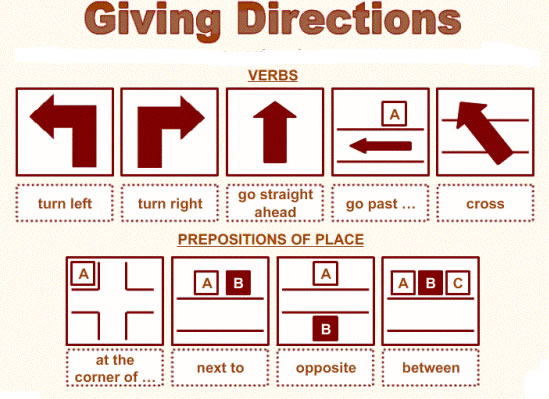
Giving directions


It's a very useful thing to know how to give directions to someone who asks us in the street or in case we are the one who need to ask.
Anyway, here is some practice 


WATCH THIS VIDEO


 EXERCISES


Exercise A:   Look at the street map. Where can you find the following items?

a.   some aspirins

b.   CDs

c.   newspaper

d.   canned goods

e.   some stamps
f.   paintings

g.   fish

h.   books

i.   letters

j.   movie

Exercise B:   Make conversation with your partner. Ask and answer about the places below.

Example:

Person 1 : Excuse me? Is there a phone box near here?

Person 2 : Yes. Go straight ahead, it's on the left between the hotel and town hall.

Person 1 : Thanks a lot.

a.   A public library

b.   A bank

c.   A public toilet

d.   A music shop

e.   A supermarket
f.   A bus stop

g.   A park

h.   A post office

i.   A school

j.   A shopping center

MORE PRACTICE

MORE EXERCISES

ANOTHER EXERCISE HERE


LISTENING

GIVING DIRECTIONS-LISTENING

HOW TO GIVE DIRECTIONS-LISTENING

martes, 5 de abril de 2016

THERE IS-THERE ARE


Here you can have some practice on "there is" and "there are".

"There is" means "hay" used with singular nouns, as in "There is a notebook on the table"

"There are" means "hay" used with plural nouns, as in "there are notebooks on the table".

But you must be very careful not to confuse "It is" and "there is" or "They are" and "there are"


Thereis/it is    they are /there are

" It is " means "es, está" or "hace" as in "It is hot" (Hace calor).
We cannot say "there is hot"

" They are " means "son, estan". "They are tall" (son altos), They're cold (tienen frío).
We cannot say "There are cold" or "There are tall"